Bickford Senior Living’s Recipe for Better Dining and Cost Control
How Aline Menus by Grove helps control food costs, cut food waste, and simplify staffing challenges.


How Aline Menus by Grove helps control food costs, cut food waste, and simplify staffing challenges.
For Bickford Senior Living, dining is central to making every community feel like home. The family-owned operator runs more than 50 independent living, assisted living, and memory care communities. Each one is designed to feel warm and inviting rather than clinical, and that philosophy extends straight into the kitchen.
“Our communities feature open kitchens, where you can see straight in, so we interact with residents all day,” said Mark McKenzie, vice president of dining. “Everything is restaurant style. We cook to order as close to consumption as possible.”
For McKenzie, who has spent 40-plus years as a chef and food service leader, this approach is non-negotiable.
“No food gets better by sitting on a steam table,” McKenzie said. “It only gets old and cold, and if residents don’t like the food, they won’t eat it. Fresh, made-to-order meals are the key to keeping people healthy and happy.”
While Bickford’s values around dining were clear, execution was more complicated. For years, each community developed its own menus, meaning 50-plus chefs were duplicating efforts with inconsistent results.
“When each chef or food service director creates their own menu, the results can vary widely,” McKenzie said. “Some menus might be excellent, others less so, and everything in between. That variability makes it difficult to ensure consistency across communities.”
The inconsistency reached far beyond the dining room. Without a unified menu, purchasing forecasts were unreliable, food costs were difficult to contain, and compliance was harder to manage. At the same time, asking so many different chefs to develop separate menus meant duplicating effort on a massive scale and wasting valuable resources that could be directed toward residents.
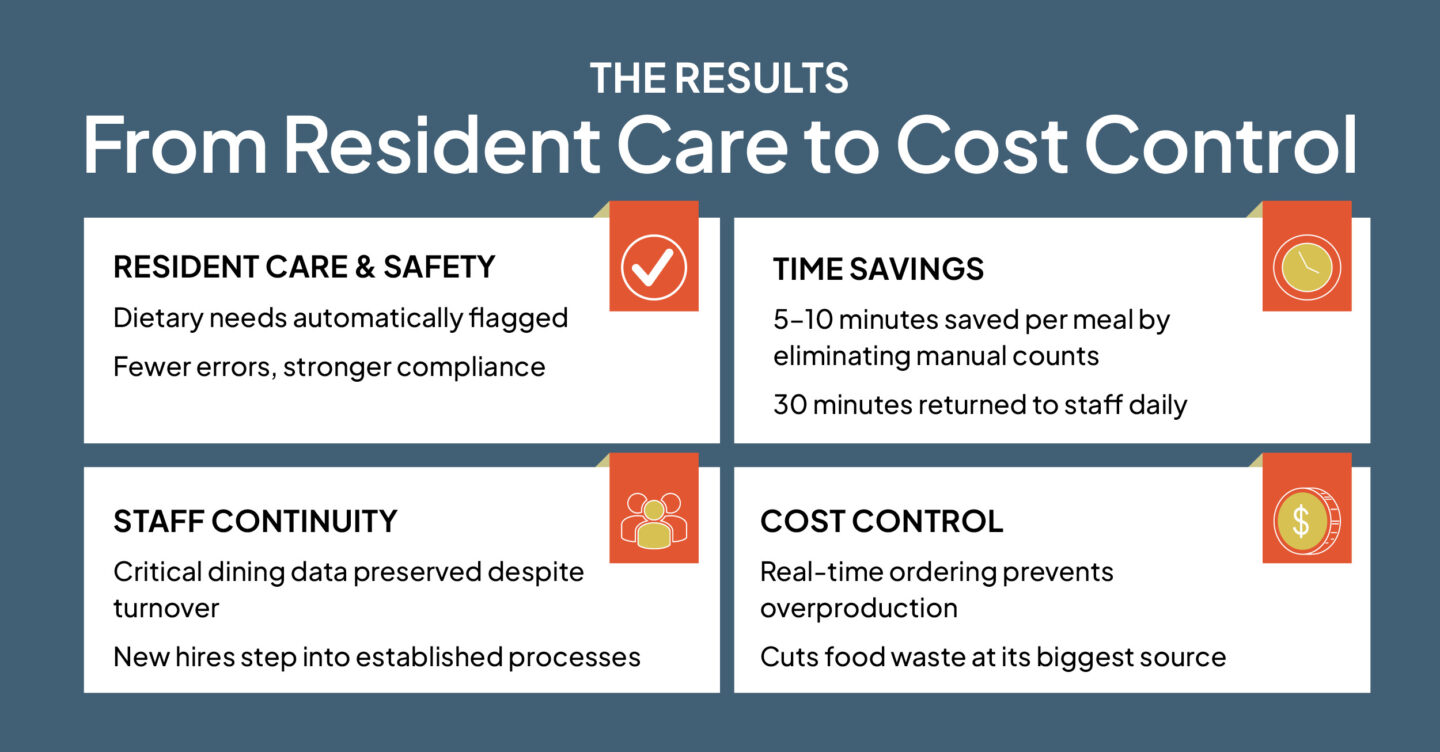
Even with menus in place, the work of managing them was labor-intensive. Forecasting and tracking consumption relied on manual processes as food managers counted tickets by hand after each meal and depended on staff to enter the numbers correctly.
“I had to physically hand-count how many chickens we served,” McKenzie said. “Relying on staff for that level of accuracy just wasn’t sustainable.”
High turnover, which is an industry-wide problem, only made the situation more difficult. As employees cycled in and out of roles, each departure meant losing valuable forecasting and production knowledge, leaving new hires to start from scratch. That lack of continuity made it nearly impossible to build momentum.
“When people quit, all the history went with them,” McKenzie explained. “The next person would come in and start from zero, and the cycle just kept repeating.”
Rising food costs added even more pressure. As inflation continued to push budgets higher, overproduction — the biggest driver of waste — remained a constant challenge. Controlling portions was essential to staying on track.
“If I have 50 residents, I need to make 50 portions,” McKenzie said. “Not 53, not 55, not 60. Every extra plate cuts into the budget.”
After struggling with inconsistent menus, manual counts, and rising costs, McKenzie began searching for a system designed for the realities of senior living dining. That search led him to Aline Menus by Grove, a dining management platform that brings menu planning, recipes, forecasting, and compliance into one place, helping operators reduce waste, control costs, and deliver high-quality meals more consistently.
“Other systems I had used were bloated and hard to manage,” McKenzie said. “Grove cut through all that. It was simple, it fit our needs, and it actually made sense for assisted living and memory care.”
With Aline Menus in place, McKenzie now develops menus centrally for all 55 communities, working with Aline Menu’s dietitian to ensure nutritional balance. Local chefs still have room to add their own specialties, but the foundation is standardized to bring both efficiency and quality.
While Aline Menus brought consistency and efficiency, Aline Point-of-Sale strengthened the system by capturing orders in real time. For McKenzie, this was critical to controlling food costs and reducing waste. Manual counts had been unreliable, and standalone POS tools only added work because they operated in isolation from menus and forecasting. Aline Point-of-Sale eliminated those gaps by living in the same system, so menu planning, ordering, and production all worked in sync.
“That kind of duplication just doesn’t work,” McKenzie said. “With Aline Point-of-Sale, everything connects, from the menu to the recipes, forecasting, and orders. It gives us one continuous process instead of pieces we have to patch together.”
Since implementing Aline Point-of-Sale, order-taking has shifted to tablets. Servers enter selections directly into the system, and dietary needs, such as lactose intolerance or diabetes, are flagged automatically. The result is fewer errors, stronger compliance, and a more resident-focused dining experience.
“Instead of filling out a hand ticket, now they carry a tablet,” McKenzie explained. “It prompts more questions, which is better for the resident experience.”
As Bickford expands Aline Point-of-Sale to more communities, it’s focused on building a dining program that delivers both operational consistency and resident-centered care. Aline Menus makes that possible by providing a single framework to manage menus, forecasting, and costs across 55 communities while still allowing flexibility at the local level.
“The software gives us one unified process across the company,” McKenzie said. “It takes the guesswork out of forecasting, keeps food costs in check, and ensures residents receive the same high-quality dining experience, no matter which community they call home.”
As adoption grows, Bickford can continue to strengthen a scalable model without losing its personal touch. For McKenzie, dining will always be more than an operational necessity — it’s a daily opportunity to support resident health and create a sense of home.
“With Aline as a partner, we’re building a dining program that lasts,” he said. “It’s consistent, it’s sustainable, and it delivers on what matters most to our residents.”

Aline
Aline helps senior care operators bring clarity to complex operations by connecting marketing, sales, clinical, dining, and financial systems on one unified platform. Serving more than 9,000 communities, Aline brings together CRM, care, billing, payments, and business intelligence so teams have shared visibility and fewer tools to manage.
Blogs, stories and studies from the forefront of senior living operations

The leasing staff at a prominent senior living operation was stretched thin by inbound calls, lead generation, and data collection. After handing these…

Holland Home uses Roobrik to reach hidden website visitors, improve lead quality, and drive move-ins through personalized, early engagement

Smarter menu planning and streamlined ordering helped Elderwood reduce waste, lower costs, and deliver more satisfying meals to residents.

With lean staffing and missed follow-ups, Park Place needed a scalable solution. Aline Contact Center brought structure, visibility, and stronger results.

Drive better senior living operational performance and improve the resident experience with actionable insights from Aline.

Discover how this senior living industry leader enhanced its sales and marketing performance with Aline Market Insights